
The Facts!Catch and Release Camplese

The Postcard Explained Below


*1-Former Chief Deputy Probate Clerk Andrea Hathaway:
“Judge Albert Camplese mandated his staff take in-person trainings on pronouns, genders and sexual orientation. Most trainings happened randomly followed with staff discussions to make sure they were addressing pronouns, genders and orientation.”



*2- Camplese is proud of shutting down the Youth Detention Center (YDC):
In 2009 then Juvenile Judge Charles Hague was forced to close the YDC for a time due to budget cuts. What did the former Judge have to say about the facility being closed?
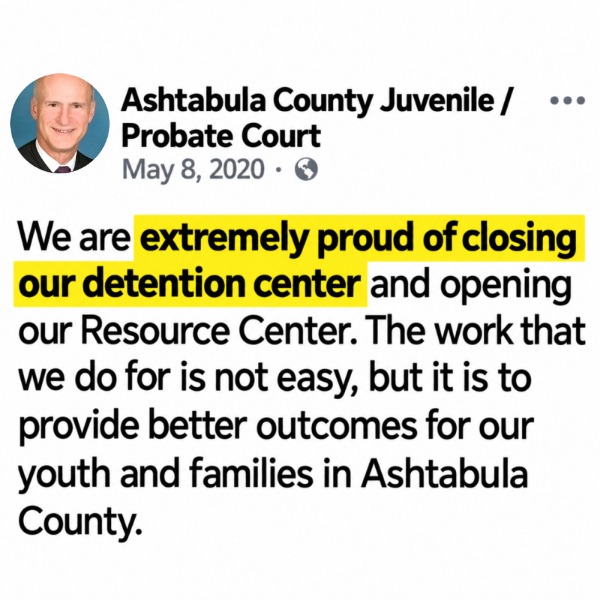
Read below: (highlighted)
ASHTABULA TOWNSHIP — Ashtabula County’s Youth Detention Center is closed.
Juvenile Court Judge Charles Hague announced the closing Friday afternoon and the layoff of 17 full-time and part-time employees. The judge cited the refusal of Ashtabula County commissioners to honor the funding agreement they struck with him in June as the reason for the closing.
“It is a very, very sad day for the justice system in Ashtabula County,” Hague said. “For all practical purposes, the juvenile justice system has ceased to exist.”
Hague filed a complaint with the Ohio Supreme Court last month, asking the court to force commissioners to honor their agreement and restore funding to the Youth Detention Center (YDC) and his Juvenile and Probate courts. The Ohio Supreme Court has not heard the case, but Hague said he has filed a motion requesting it be accelerated on the docket.
Until such action is granted and the matter resolved in Hague’s favor, or a new fiscal year begins in January 2010, YDC will remain closed for lack of funding. Hague said it would take about $170,000 to keep it open through the end of 2009.
Two employees will remain at the facility during the shutdown and perform maintenance, such as painting. The cost of the unemployment insurance premiums for the others will have to be borne by the county.
YDC is the county’s only facility for holding youth, generally those aged 12 to their 18th birthday, who are being processed for a crime or awaiting transport to a state facility after sentencing. Hague said he will have no other choice but to release young offenders. In some cases, social service agencies can step in and fill some of the void with programs, like anger management, and custodial care, but there won’t be any place to “lock up” youth who are awaiting court hearings or transportation to state facilities.
Sheriff William Johnson said the county jail cannot house young offenders, even if one floor is set aside just for that purpose.
“It can’t be in the same facility,” Johnson said.
He feels the result of the closing will be that deputies will have to spend more time on cases involving youth because they’ll have to hold suspects until a responsible party can be located to whom the youths can be released.
“It ties up a unit,” Johnson said. “We can’t walk away from it.”
Johnson said if a serious crime rather than a “simple assault” is involved, then the county will have to find another facility outside its borders to house the young offenders.
Hague said that with YDC closed, the court has been stripped of its ability to fulfill its function.
“My orders are worthless. Our power has been usurped,” he said.
Hague began the process of emptying the 20-bed facility last month (it is licensed for only 10 of those beds). He said the inmates have been released to parents, custodians and guardians.
“I fear greatly for the safety of the community,” the judge said. “There is going to be nowhere for these youth to be detained, either at the point of arrest or after whatever the court action is. Law enforcement will have no choice except to release them back to wherever they came from.”
What kinds of offenders are held at YDC? Hague says domestic violence accounts for a substantial number of admissions, but there are also many sex-related crimes.
“Sex crimes, I guess you could say, are rampant among juveniles,” he said.
“That’s not to mention the drug trafficking, use, at the school, on the school bus,” the judge continued. “That’s not to mention the weapons, the guns, the knives, the ‘nunchucks,’ brass knuckles. We had a kid on the bus with a gun two weeks ago. I fear for this community.”
Hague said that, to his knowledge, this is the first time a youth detention center has closed in the state and it is definitely the first time the county’s has closed. He places the blame squarely on the shoulders of the county commissioners, whom he accuses of stripping his court of its power and independence by way of the purse strings.
“It is this judge’s humble opinion that the commissioners of Ashtabula County have taken complete control of the probate and juvenile-justice system by refusing to fund it at a level at which it can do its constitutional, statutory duties,” Hague said. “One of our forefathers said ‘The measure of government is how it treats its vulnerable citizens, its youth, its elderly.’ By the actions of these commissioners, we have certainly flunked that test with flying colors.”
Hague said he could not provide an estimate of how much his legal action will cost the county but said it will be far in excess of the $170,000 it would cost to keep YDC open.
Board of Commissioners President Peggy Carlo said if Hague were to prevail in court and be granted his funding, it would devastate county government because of the cuts that would have to be made elsewhere.
“It’s not the best way to go,” she said of the litigation. “I wish we could have done it another way.”
She said YDC’s closing is “terrible.”
“It’s one of the worst things that can happen to our county,” Carlo said.
Another article:
Ashtabula County Juvenile Court to use Lake County detention space
The Lake County commissioners recently adopted a resolution authorizing a partnership agreement between the Lake County Common Pleas Court, Juvenile Division, and Ashtabula County to temporarily house youths in Lake County.
According to officials, Lake County will secure detention space while Ashtabula detainees await adjudication, disposition or placement elsewhere, as the county “no longer has a facility.”
Lake County Juvenile Court Judge Michael DeLeone noted that the auto-renewal contract — “unless opted out in writing” — operates on a per diem basis.
“The regular rate,” he said, “stands at $225 while the ICR (Intensive Community Rehabilitation) Unit rate stands at $300,” he said.

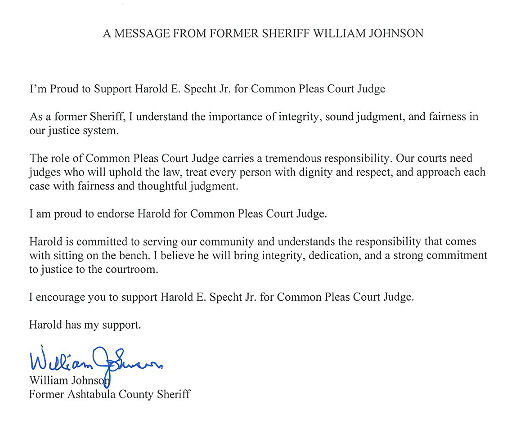
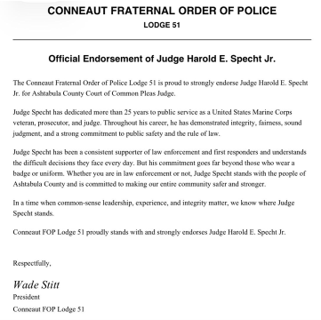
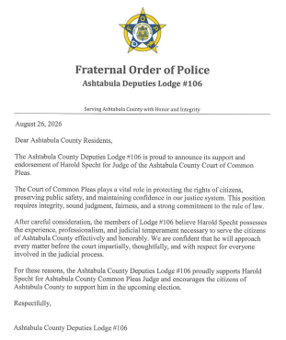
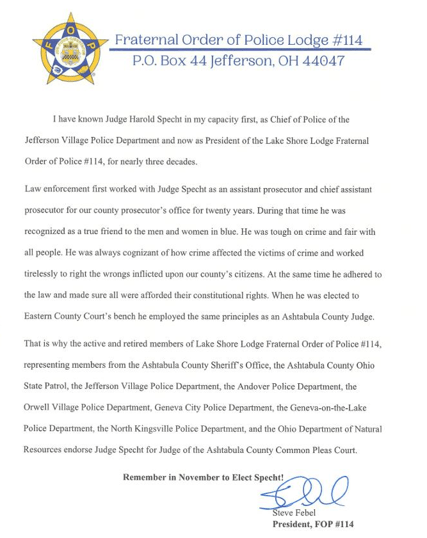
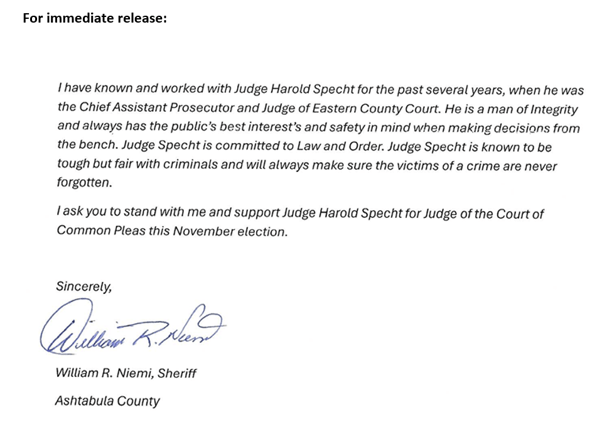
*3 – Endorsements for Judge Harold Specht
Click on any image below to read endorsement

A Camplese yard sign says more than a thousand words – at minimum, 73!

Would you like to become one of our donors?
Would you like to become one of our donors?
